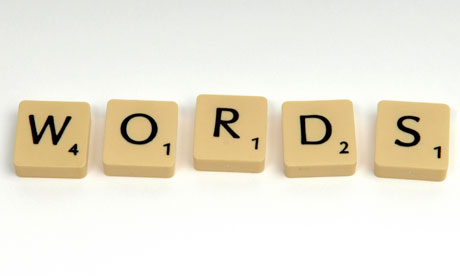
"How do you spell [insert word]?" "Is [insert hopeful word] a real word?" "What does [insert word] even mean?"
If you've ever played Scrabble, Banana-grams, or pretty much any game involving words, someone is always asking how to spell certain words or coming up with words that don't exist. It is clear that words have to have a specific standard of spelling and meaning (however arbitrary spelling rules may be) so that our society can communicate (and play Scrabble). We can't all spell words differently or use them for different meanings or there will be total chaos just when someone texts you asking you to buy cereal.
There are people around today who will say that words are just sounds to which we attach meaning. Supposedly, we can make words mean whatever we like. Ironically, those people are using words to express that thought...
The point is, words are integral to our society's functioning because they allow us to communicate ideas.
So, if words are so powerful, we should use them carefully, right? I mean, if you can just say a word like "snowman" and whoever you're talking to immediately imagines a figure made out of cold, wet snow with a top hat and carrot nose and possibly singing, you need to make sure you only say "snowman" when you want someone to think of a snowman.
But we use our words so carelessly, don't we? Words like "love" and "hate" express intense emotional actions, and yet we use them to refer to movies, shampoos, and our opponents in a card game. We live in a culture with a lot of exaggeration--everything is "the best", "the worst", "the biggest", or "epic". We throw around "love", "hate", "awesome", and other intense words that really have no place in those contexts.
I'm not saying not to use those words casually. I know it would be next to impossible to restrain ourselves to only using those extreme words in a few select contexts. What I'm saying is that we often cheapen the meaning of words so much that we end up using harsher words that can hurt people. We've established that words have meaning; therefore, if you tell someone that you hate them, they will get the impression that you wish they were dead or worse. And while in playful contexts, we can usually get away with teasing our friends with extreme words by laughing and saying "just kidding", some times it gets carried away. Whoever is talking may not mean to come across spitefully, but whoever he is talking to may get hurt anyway.
There is a saying, "Sticks and stones may break my bones, but words will never hurt me." Anyone who has been on the brunt end of teasing knows there is nothing farther from the truth. Words can make your day, or they can devastate you. We regulate all weapons that can hurt for a few weeks or even years, but the one weapon that can cut deeper than any bullet is the one we can't control (check out James 3).
Words are powerful. Use them carefully. If you don't, you might end up saying something you don't mean, or saying it in a way you didn't intend. We need to use our words to bring others up and show them the love of Christ, not tear each other down.
Despite the fickle and hurtful words in our world, there is one Word that we can always trust. Christ is our Solid Word, upon which we can always set our hopes. His Word is alive, and it will never fade away.

No comments:
Post a Comment